Weather alerts, watches, warnings and advisories
On this page
Weather shows the alerts the National Weather Service has in effect: watches, warnings, advisories and statements. You see them on a place's pages, on a state's page and on a page for the whole country, most urgent first, each with the Weather Service's own text and instructions.
#Where alerts appear
- On a place's pages. Colored bars under the tabs name each alert in effect for the place, with when it ends. Up to four are shown, then a line for the rest. The Alerts tab shows how many there are.
- On the place's Alerts tab, every alert in full.
- On the Weather overview, a Severe weather now box counts the alerts in effect by kind, and lists the states with the most.
- On the Alerts page in the row of Weather pages, every alert in the country, or in one state.
- On a state's page, its alerts as bars at the top. In city tables, a red tag such as 1 alert marks a city with an alert.
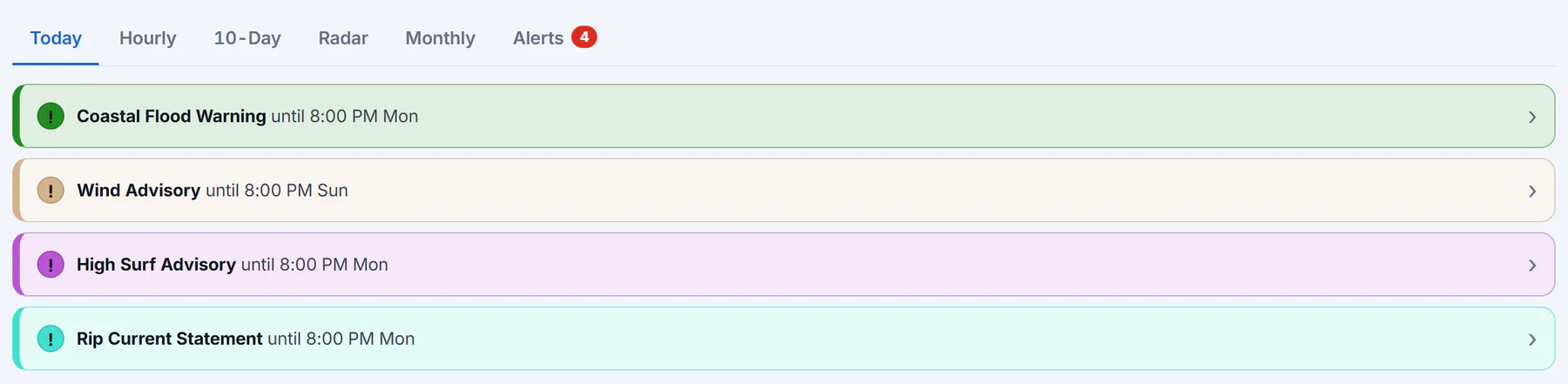
Alert bars on a place's page. Each opens that alert in full on the Alerts tab.
- 1An alert in effect here, with how long it lasts
- 2The Alerts tab shows how many
#Watches, warnings and advisories
The alert's name says what kind it is. These are the National Weather Service's general meanings:
| Word in the name | What it generally means |
|---|---|
| Warning | The hazard is happening or about to happen. Take action. |
| Watch | Conditions could produce the hazard. Be ready to act. |
| Advisory or Alert | A less serious hazard that can still be a nuisance or a danger. Take care. |
| Statement | Information or an update about weather in the area. |
Each alert's own text, under What to do, says what the Weather Service advises for that alert. Read it rather than going by the name alone.
#Colors
Each kind of alert has its own color, the same one the National Weather Service uses on its hazard map, so a Tornado Warning looks as it does on weather.gov. The color tells you which hazard it is, not how serious: read the name to know whether it is a warning, a watch or an advisory. Lists are ordered by the Weather Service's own order of urgency, with life-threatening warnings first.
#Read an alert
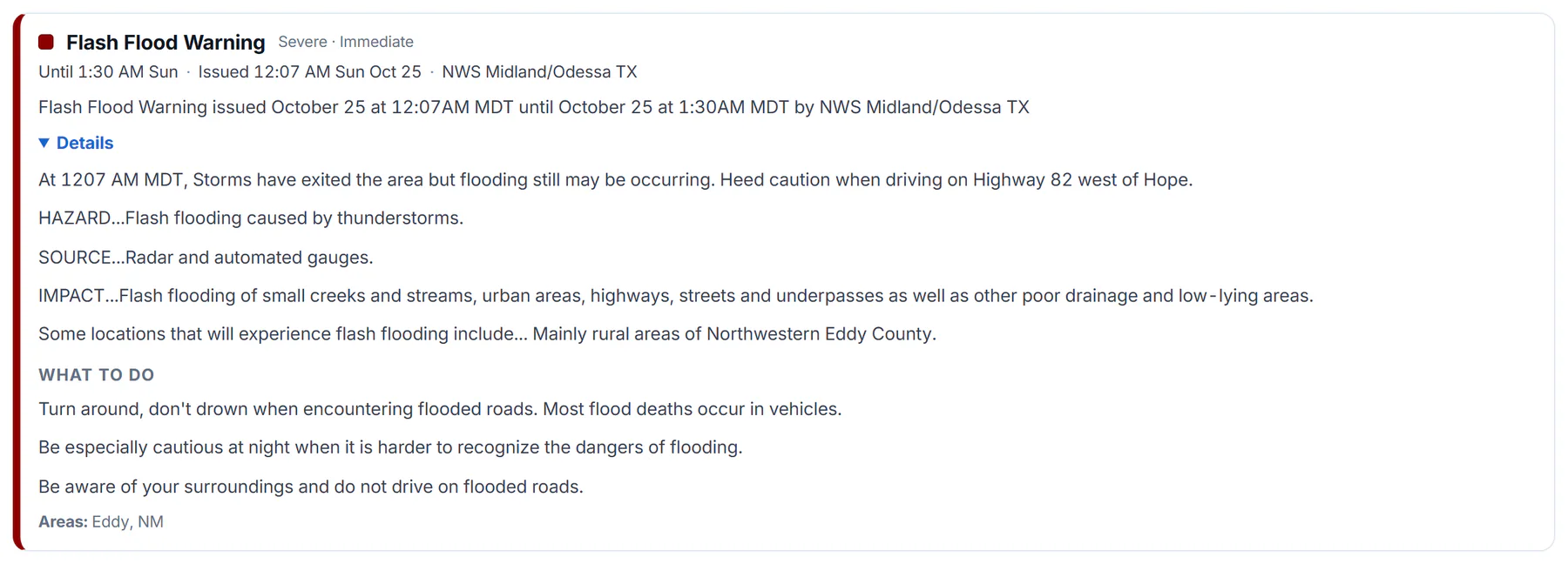
One alert in full, with its details open.
- 1The kind of alert, with its severity and urgency
- 2How long it lasts, when it was issued and by whom
- 3The full text and what to do
- 4The areas it covers
- The name, with a color swatch, and its severity and urgency as the Weather Service gives them, such as Severe · Immediate.
- When. How long it lasts (or when it starts, if later), when it was issued and which Weather Service office issued it. On a place's page, times are the place's own. On the national page, times are local to the first state the alert names.
- The headline, in the Weather Service's words.
- Details, which unfolds the full description and What to do. On a place's Alerts tab the details are open; on the national and state pages, select Details.
- Areas, the counties or zones the alert covers.
#Alerts for the whole country or one state
Select Alerts in the row of Weather pages. The page says how many alerts are in effect over land and lists them grouped by kind, most urgent first, with a count for each kind. The State menu opens one state, and the By state box lists the states with alerts and how many each has.
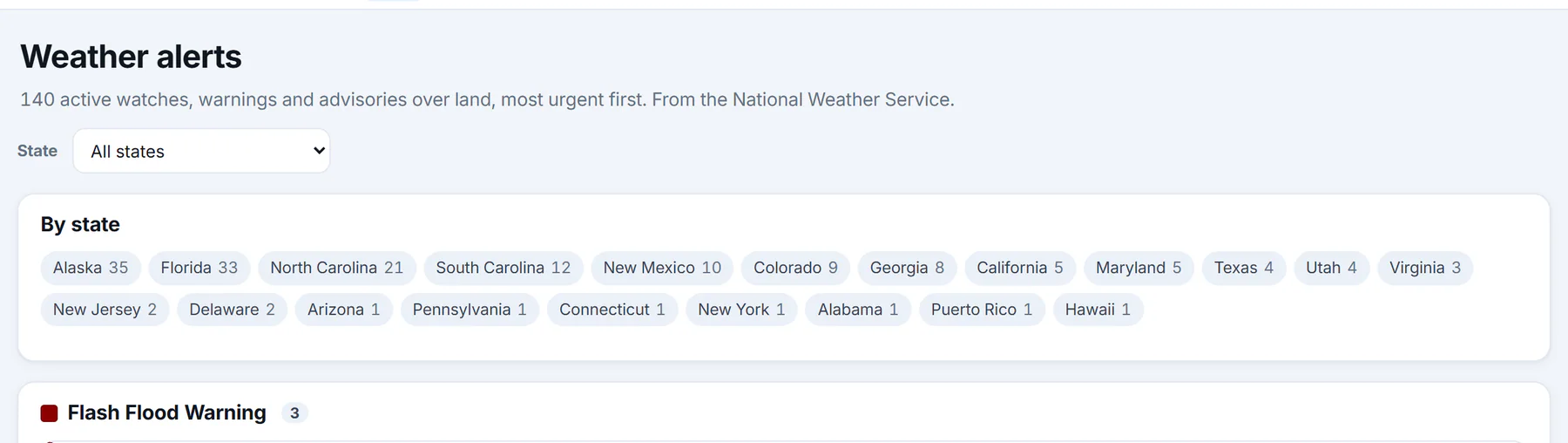
The national Alerts page: the count, the State menu, the states with alerts and the first group of alerts.
- 1How many alerts, most urgent first
- 2Pick a state
- 3States with alerts, and how many
- 4One kind of alert and how many there are
A place's alerts are those for its forecast zone and county. When none are in effect, its Alerts tab says so and names the zone and county, with a link to all the alerts in its state. Alerts are for U.S. places only.
#Common questions
Why does my place show no alert when there is one nearby?
An alert covers named zones and counties. If yours is not among them, it is not shown for your place. Open the Alerts page for your state to see everything near you.
Does 4Search send alerts to my phone?
No. Weather shows alerts when you open a page. For alerts sent to you, use the official alerting services on your phone and from your local officials.
Why does the radar show colored areas?
With the Warnings layer on, the radar map draws the areas under active watches, warnings and advisories in their colors. See Use the radar map.
Are alerts shown for places outside the United States?
No. Alerts come from the National Weather Service and cover the United States and its territories.